You might not think of greenhouse polythene as a technical decision. It’s plastic sheeting, so how complicated can it be? The answer is, quite a lot.
The wrong greenhouse polythene – wrong thickness, wrong color, wrong UV specification, wrong properties for your specific crops – can mean a cover that fails prematurely, a growing environment that damages the crops it’s supposed to protect, or a greenhouse that underperforms for years before anyone figures out the problem.
The right greenhouse polythene, on the other hand, creates a stable, well-lit, protected environment in which crops genuinely thrive. Getting there is less about finding the cheapest roll and more about matching the specification to what your greenhouse actually needs.
Here’s how to make that decision properly.
Start with Thickness: Why 200 Microns Is the Standard
Greenhouse polythene in Kenya comes in several thicknesses, commonly 150 microns and 200 microns, with 200 microns being the industry standard for serious commercial and smallholder applications.
That difference matters. Thicker film is physically stronger. It resists tearing under wind load, handles the physical stresses of installation, and recovers better from incidental contact with sharp edges on the frame or accidental handling during crop management inside the greenhouse.
A 150-micron film is adequate for a very lightly used, short-term application but is not the right choice for a greenhouse you intend to farm in seriously for three to five years.
Approach UV Stabilization as Non-Negotiable
Kenya sits almost directly on the equator. The intensity of ultraviolet radiation at this latitude is among the highest in the world, and it is the single most destructive force acting on your greenhouse polythene from the day it’s installed.
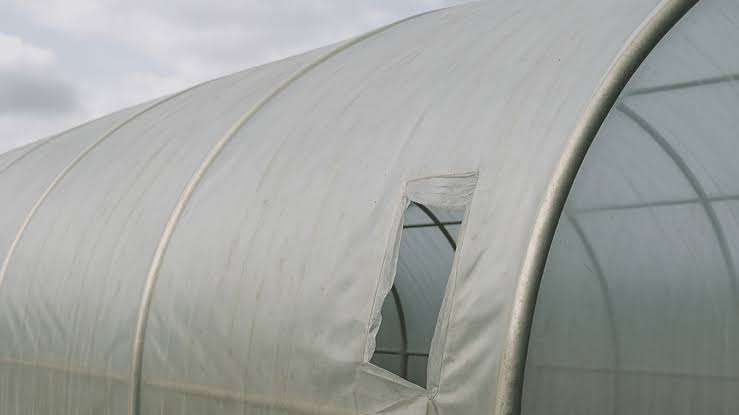
Without UV stabilization, greenhouse polythene begins degrading quickly under this exposure. It will quickly become brittle, develop small cracks, lose transparency, and eventually tear. A non-UV-stabilized cover in Kenya’s climate can fail within a single growing season.
UV-stabilized polythene contains specific chemical additives: UV stabilizers and antioxidants that absorb or neutralize UV radiation before it can break down the polymer structure of the film. These additives extend the usable life of the cover to three to five years under normal conditions, and up to six years with proper care.
Add Anti-Drip Properties, a Small Detail with Big Consequences
Inside a greenhouse, temperature differences between the warm air and the cooler polythene cover cause moisture to condense on the inside surface of the film. With standard polythene, this condensation forms individual water droplets that grow heavy enough to fall directly onto the crops below.
Droplets landing on leaves and fruit create localized wet spots that can be perfect entry points for the fungal pathogens that cause grey mold, downy mildew, and a range of other diseases that thrive in exactly the warm, enclosed environment of a greenhouse.
Anti-drip greenhouse polythene contains surface additives that change how condensation forms on the inside surface. Instead of individual droplets, moisture forms a continuous, thin water film that flows down the sides of the cover to the edges rather than dripping.
The result is a drier crop canopy and meaningfully lower disease pressure from moisture-related pathogens.
In a greenhouse growing tomatoes, capsicum, roses, or any crop where foliar disease is a significant risk, anti-drip polythene is worth specifying as standard.
The additional cost over plain film is modest, and the disease management benefit it provides across three to five years of use is real.
Diffuse vs. Clear Film: How Light Distribution Affects Your Crops
Standard clear greenhouse polythene is highly transparent. Light passes through it in roughly the same direction it came from, meaning the sun’s beams enter the greenhouse as direct light and create the same patterns of brightness and shadow you’d find outdoors, just intensified by the enclosed space.
Diffuse polythene film contains light-scattering additives that break up incoming light as it passes through, spreading it more evenly in all directions through the interior.
The effect is similar to the light quality on a bright overcast day; evenly distributed, soft, reaching plants from multiple angles rather than in concentrated beams from above.
For most vegetable crops, diffused light improves the uniformity of growth across the planting area.
If your greenhouse will be growing high-value crops where uniformity and quality directly affect what price you achieve at market, the modest premium for diffuse polythene is a worthwhile investment.
Color: Yellow or Clear?
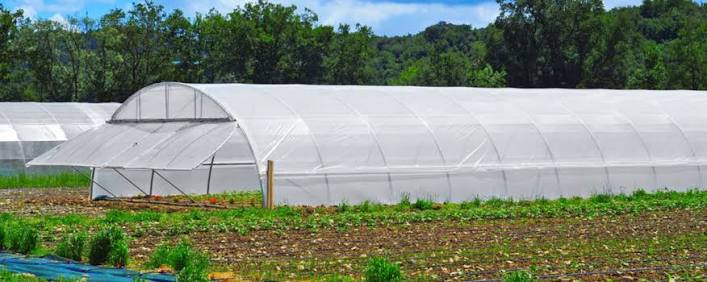
Greenhouse polythene in Kenya is available in two main color options: clear (milky white) and yellow. Both are UV-stabilized and available in 200-micron specifications, but they interact differently with the light they transmit.
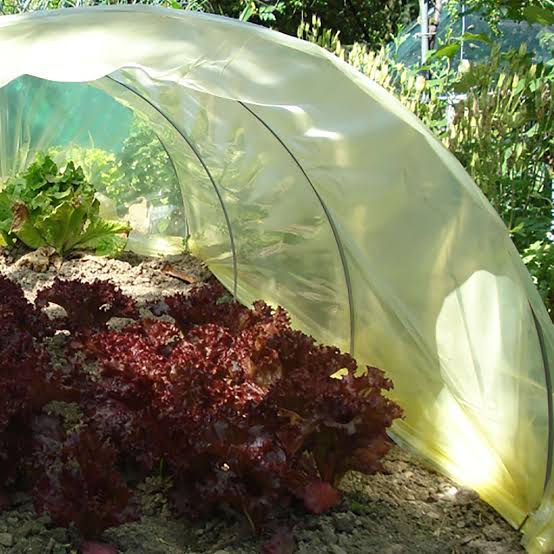
Yellow polythene sheet for greenhouse gives the light inside the structure a warm cast and is associated with slightly higher internal temperatures than clear film, which makes it a preferred choice in cooler, higher-altitude farming areas where retaining warmth matters.
It also has known benefits for crops such as cucumber and multi-colored flowers, where its light spectrum properties support specific aspects of the crop’s development.
Clear milky-white film is the more common choice for general vegetable production across a broad range of Kenyan conditions.
Its light transmission is neutral; it creates a brighter internal environment, and it is suitable for the widest range of crops.
If you’re new to greenhouse farming and growing mixed vegetables, clear film is the safe starting point.
Sizing and Installation Considerations
Greenhouse polythene in Kenya is available in widths of up to 14 meters, which allows a single continuous sheet to cover the full span of most standard tunnel greenhouse configurations without a seam along the roof.
Seamless cover installation is preferable, as seams are potential failure points. Avoiding seams on a polythene greenhouse where possible is always better structural practice.
When installing a greenhouse polythene, ensure you bury the bottom edge of the film into the soil along the sides of the structure by at least 30 centimeters to prevent wind from undercutting it and to block the entry of crawling pests and insects at ground level.
Original Reliable Greenhouses in Nairobi, Kenya at Irrihub Ke, +254 112 148 880
If you are looking to buy reliable, high-quality greenhouses in Kenya, Irrihub has some nice offers you may consider. We sell greenhouses and other growing solutions as independent units or as complete solutions (kits). The complete greenhouse solutions include:
- A galvanized steel structure
- 200-micron polythene cover (clear or yellow)
- Zig-zag fastening wires to hold the cover against the wind
- Roll up side ventilation with white insect net
- Entry porch
- Full drip irrigation system
- Water tank (size depends on greenhouse tier)
- 2-year warranty on structure and materials
- Optional crop support structure for climbing crops
Final Thoughts
Even the best greenhouse polythene has a finite life, and it helps to know when to replace it.
When the cover begins losing transparency noticeably, develops persistent brittleness or cracking, or shows tears that exceed what patch repairs can reasonably address, replacement is the right call.
Small tears can be repaired with greenhouse adhesive tape as a short-term measure. However, large tears, or a cover that is degrading broadly across its surface, should be replaced rather than progressively patched.
Plan for replacement on a three- to five-year cycle, budget for it in advance, and treat replacement as a routine maintenance event rather than an unexpected cost. A fresh, correctly specified greenhouse polythene cover is the starting point for another several years of productive, protected growing.