Every greenhouse begins with a frame. But it’s the cover, the material stretched over that frame, that actually does the farming work. The greenhouse cover material determines how much sunlight reaches your crops, how well the structure retains heat at night, how long the investment lasts before replacement is needed, and how much of your budget goes into materials versus everything else.
Choosing the right greenhouse cover material is therefore one of the most consequential decisions you’ll make in the entire project, and it deserves considerably more thought than simply asking what’s cheapest or what other farmers use.
Here’s a clear comparison of the main options available to Kenyan farmers, what each one does well, and where each one falls short.
Greenhouse Polythene (Polythene Film)
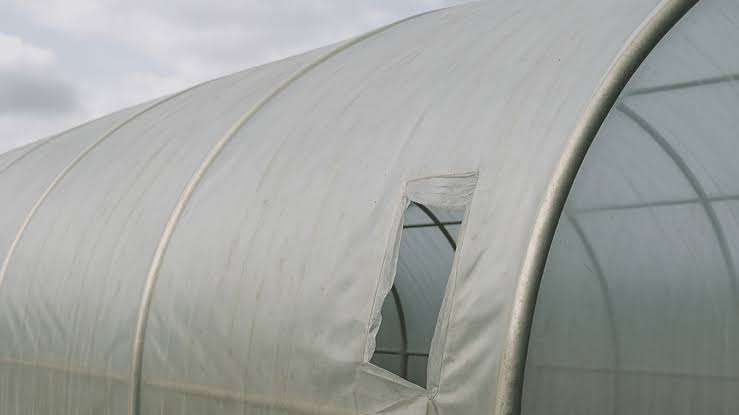
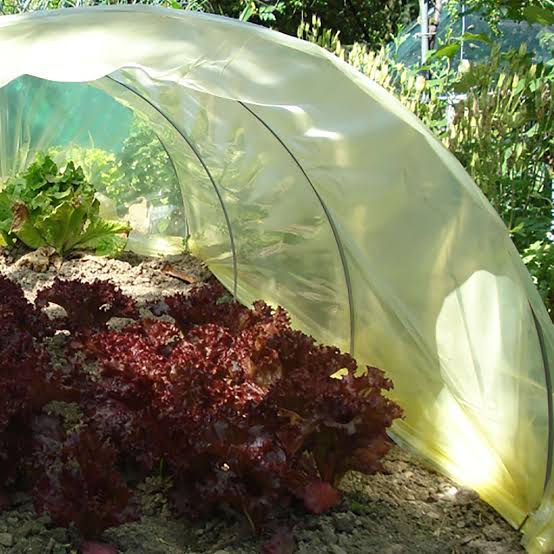
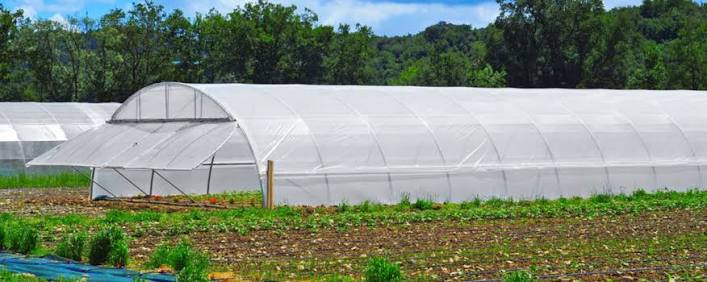
Walk around any farming region in Kenya, and it won’t be long before you spot a greenhouse covered in the familiar milky-white or yellowish translucent film that catches the light in the morning sun.
That’s polyethylene film, polythene, and it’s the dominant greenhouse cover material across Kenya and East Africa for several very good reasons.
Polythene transmits 80-90% of available light, which is excellent for crop growth. It’s flexible and straightforward to install over curved or arched frames, making it the natural match for the tunnel-style greenhouse structures that are most common in Kenya.
And it is, by a significant margin, the most affordable of the main covering options on the market.
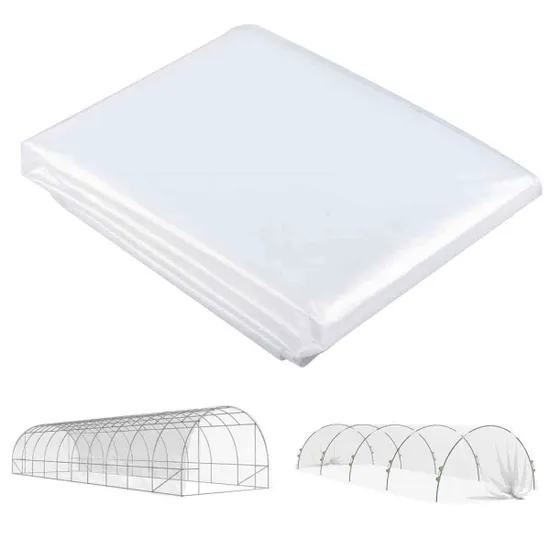
The critical specification details are thickness and UV treatment. In Kenya, 200 microns is the standard for commercial and serious smallholder use for maximum durability and resilience against wind, rain, and the stresses of installation and maintenance, as far as this greenhouse cover material is concerned.
Some significant mentions beyond the basic clear film include the following:
- Anti-drip film
This type of greenhouse material contains additives that cause condensation on the inside surface of the cover to form a continuous water sheet rather than individual droplets.
Droplets fall directly onto crops, creating wet spots on leaves and fruit that are entry points for fungal disease. Anti-drip treatment routes that moisture harmlessly down the sides of the film instead.
- Diffuse film
It scatters incoming light as it passes through the cover, distributing it more evenly through the interior of the greenhouse rather than allowing concentrated beams of direct sunlight to reach the crops.
Diffused light reduces shadows between plants, softens the intensity of midday sun on sensitive crops, and promotes more uniform growth across the entire planting area, essential for high-value crops like tomatoes and capsicum.
- Yellow and clear color options
These greenhouse cover material color options are both common in Kenya, each with different light properties.
Yellow film is associated with slightly warmer internal temperatures and is often recommended for higher altitudes or cooler climates.
Clear milky-white film is the more common choice for general vegetable production across a range of conditions. Both are available in 200-micron, UV-stabilized specifications.
Polycarbonate Panels
Polycarbonate panels are rigid, semi-transparent plastic panels that clip or slot into frames designed to accommodate them. These greenhouse cover materials boast better insulation, but at a higher cost.
Thermal insulation is the main advantage of polycarbonate over polythene. Multi-wall polycarbonate panels trap heat significantly more effectively than a single layer of polythene film.
Twin-wall polycarbonate provides an insulation rating roughly double that of single-pane glass, and considerably better than polythene film. For a farmer in a colder highland area where night temperatures regularly drop low enough to stress crops, that insulation difference has real value.
Polycarbonate is also physically more durable than film. It’s impact-resistant, won’t tear in wind, and doesn’t need to be replaced every four to six years. A good quality polycarbonate panel with a proper UV coating will last 10 to 15 years.
The trade-off is cost. Polycarbonate panels are significantly more expensive than polythene film, both in material price and in the additional structural complexity they require. A polycarbonate greenhouse typically needs a more rigid, more precisely constructed frame.
For most Kenyan farmers investing in protected growing for the first time, or operating at smallholder to medium commercial scale, polycarbonate is difficult to justify on the grounds of cost when well-specified polythene performs adequately for their needs.
Glass: The Premium Option
Glass is the original greenhouse covering material and remains, in some respects, the benchmark against which other materials are measured.
This greenhouse cover material boasts unmatched light transmission. Approximately 90% of visible light passes through glass, unchanged by UV exposure or aging, and it maintains that transmission rate essentially for the life of the structure.
Glass also doesn’t yellow with time, and neither does it degrade in sunlight. Additionally, a glass greenhouse carries an aesthetic solidity that polythene and polycarbonate greenhouse cover materials can’t quite replicate.
In the Kenyan context, however, there are significant practical challenges making glass greenhouses uncommon.
One, glass is heavy, so it requires a substantially stronger and more expensive frame to support it safely. Glass panes are fragile enough to get cracked or shattered by a hailstorm, a falling branch, or a mishandled tool, creating both a safety hazard and an immediate repair cost.
Furthermore, single-pane glass offers the lowest thermal insulation of any covering material, meaning the heat that builds up inside during the day escapes quickly at night. And the cost of a glass greenhouse structure, from frame through to glazing and installation, is considerably higher than a polythene or polycarbonate equivalent of the same footprint.
Original Reliable Greenhouses in Nairobi, Kenya at Irrihub Ke, +254 112 148 880
If you are looking to buy reliable, high-quality greenhouses in Kenya, Irrihub has some nice offers you may consider. We sell greenhouses and other growing solutions as independent units or as complete solutions (kits). The complete greenhouse solutions include:
- A galvanized steel structure
- 200-micron polythene cover (clear or yellow)
- Zig-zag fastening wires to hold the cover against the wind
- Roll up side ventilation with white insect net
- Entry porch
- Full drip irrigation system
- Water tank (size depends on greenhouse tier)
- 2-year warranty on structure and materials
- Optional crop support structure for climbing crops
Conclusion on Greenhouse Cover Material for Kenyans
The honest answer is this: for most Kenyan farmers at smallholder to medium commercial scale, high-quality 200-micron UV-stabilized polythene film is the right greenhouse cover material.
It delivers excellent light transmission, proven performance in Kenya’s climate, easy installation over standard tunnel frames, and a cost that keeps the overall greenhouse investment at a level most serious farmers can reach.
For a minimum upgrade, you can go for anti-drip treatment. The plant health benefit that comes with this greenhouse material option is real, and the cost difference is modest.
If your crop plan involves high-value vegetables or flowers where the uniformity of sunlight directly affects quality and price, diffuse film is worth considering. And when the time comes for replacement, treat that replacement as an opportunity to upgrade specifications if the farm’s performance justifies it.
Polycarbonate and glass both have their place in the broader greenhouse ecosystem. For most Kenyan farmers right now, the place to start is with the material that already works, done properly.