Solar Water Pump Sizing Guide: Calculate Head, Flow, and Power Needs
Choosing a solar water pump by price alone without considering site data can be a reliable way to end up with a system that disappoints. An undersized system won't deliver enough water, while an oversized one wastes money. This is why you need this solar water pump sizing guide to help you understand how to calculate head, flow rate, and power needs so your system performs efficiently.
If you are a farmer in Kenya, proper sizing is essential to ensure reliable irrigation, especially when using a solar panel water pump in off-grid conditions.
By the end of this solar water pump sizing guide, you should have a working framework to size any solar water pump for irrigation, domestic supply, or deep well borehole application.
Step 1: Calculate Your Water Needs (Flow Rate)
Flow rate refers to the volume of water required over a specific time, usually measured in liters per hour (L/hr) or liters per day (L/day). It answers the question regarding how much water the system needs to deliver per day, and how quickly the pump must work to deliver it during available sunlight hours.
The amount to be pumped here will depend on the number of animals or crops that need water per day, and what irrigation method you use.
For example, drip irrigation for 1 acre may require 5,000 to 10,000 liters of water per day. Similarly, livestock watering will depend on the number of animals you have in your farm.
A properly sized solar water pump for irrigation must meet this demand consistently.
Step 2: Determine Total Dynamic Head (TDH)
Total Dynamic Head (TDH) is one of the most important sizing factors. It represents the total height and resistance the pump must overcome to deliver water from the source to where it is required. If you get this figure wrong, nothing else in the sizing process may matter.
The Total Dynamic Head has three components that you must add together in this calculation:
1. Vertical Lift – This is the depth of the water source, for example, the depth of your borehole.
2. Delivery Height – This is the height from the ground level to the storage tank. It is also called static head, and is calculated as the vertical distance from your water source surface to the delivery point, such as the inlet of your storage tank, header tank, or irrigation connection point.
3. Pipe Distance and Friction Loss – This is the horizontal distance that the pipe must cover, together with the resistance caused by pipes and fittings. This calculation, also referred to as the friction head, accounts for the pressure lost as water moves through pipes, fittings, bends, and valves.
Here is a simple formula for calculating the TDH:
TDH = Vertical Lift + Delivery Height + Friction Loss
For example, suppose the Borehole Depth is 40m, the tank height is 10m, and the pipe losses are 5m, the Total Dynamic Head is 55m.
As a key takeaway in this solar water pump sizing guide, your solar water pump for deep well must be powerful enough to handle this total head.
Step 3: Calculate Required Pump Power
Once you know your flow rate and head, the next step is to estimate the power needed to push and deliver water to where it is required.
Pump power depends on the water volume (flow rate), total head, and the pump’s efficiency. While the exact calculations can get technical, the key idea is simple:
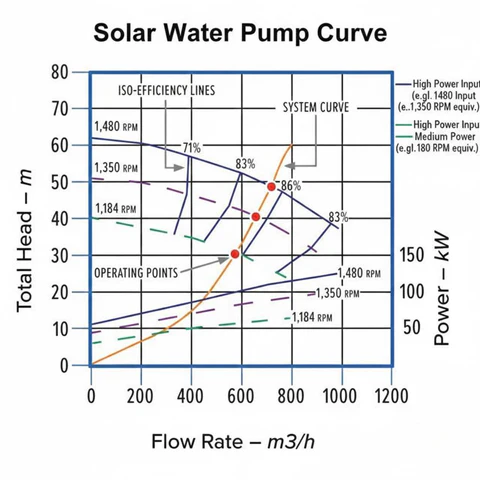
Higher head + higher flow = more power required
This is pretty much everything you need to pay attention to as far as calculating the required pump power. This is why deep boreholes need stronger pumps than shallow water sources.
Step 4: Size The Solar Panels
Ultimately, without the right solar panels to provide the system with the required electrical power, all these calculations are nothing. Solar panels must generate enough energy to run the pump efficiently.
Ideally, consider the pump requirements, average sunlight hours in your location (typically 5 to 7 hours per day in Kenya), and system efficiency.
Every pump motor has a rated input power expressed in watts. So, for example, if you have a pump requiring 1 kW of power, you may need 1.2 to 1.5 kW of solar panels to operate it reliably.
Do not go for an undersized panel setup, as that will result in weak water flow, intermittent pumping, and overall system inefficiency.
Step 5: Match With the Right Controller
Once you have all the above calculations, the next essential part of this solar water pump sizing guide is efficiency of power use, and that is where the controller comes in. The solar pump controller ensures that power from the panels is used efficiently by regulating voltage and adjusting performance based on sunlight. This way, it also helps protect the pump.
MPPT controllers are especially useful because they maximize energy output and improve performance during cloudy conditions.
Original Reliable Solar Water Pumps in Nairobi, Kenya at Irrihub Ke, +254 112 148 880
If you are looking to buy a reliable solar water pump in Kenya, Irrihub has some nice offers you may consider. We sell solar pumps as independent units or as complete solutions (kits). The complete solutions include:
- Submersible brushless pump
- 600W solar panels
- Delivery pipe 25MM
- 70M head
- Flow rate of 2300 L/hr.
- Solar panels
- Pipes and fittings
- Cables
- MPPT controller
- Full installation
Solar Water Pump Sizing Guide Conclusion
This solar water pump sizing guide shows that getting the right system is all about balancing head, flow, and power. Ultimately, the crucial thing is to carefully calculate your water needs and match them with the right components in order to build a system that is both efficient and reliable.
Proper sizing is the key to long-term success, whether you are installing a solar water pump for irrigation or a solar water pump for deep well. It ensures that your farm has the water it needs to thrive.
We hope this guide helps you out. If you have any questions or need any assistance, don’t hesitate to contact the experts over at IrriHub to help.
solar water pump sizing guide; Supporting Keywords: solar water pump for irrigation, solar water pump for deep well, solar panel water pump, solar pump controller