A well-designed irrigation system does not start with the pump; it starts with the design. Regardless of whether you are drawing water from a borehole, river, or dam, the effectiveness of your setup depends on how well all components work together. That’s where the solar pump system design becomes critical.
While farmers in Kenya enjoy the abundance of sunlight in most parts, resources must be used efficiently, and therefore, a properly designed solar pumping system is crucial. It goes a long way in ensuring reliable water delivery, lower costs, and long-term performance.
This guide walks you through the key principles that define an efficient water delivery system. Let’s dive right in.
- Design Around Total Head, Not Borehole Depth
The total head and borehole depth are two related concepts, but not the same thing.
The total head – It is the total vertical and frictional resistance the pump must overcome to deliver water at the required flow rate to the required point.
It has three components, namely: the static head (the vertical distance from the water surface in the source to the point of delivery), the friction head (the pressure loss caused by water moving through the pipes, bends, fittings, and valves), and the dynamic drawdown (the vertical distance the water level in a borehole lowers from its original resting position, or static water level, when a pump is operating).
When the solar pump system design is correct, the system calculates the total head as the sum of all three components and selects a pump whose performance curve delivers the required liters per hour at that total head value.
- Match the Solar Panel Capacity to the Pump Power Demand
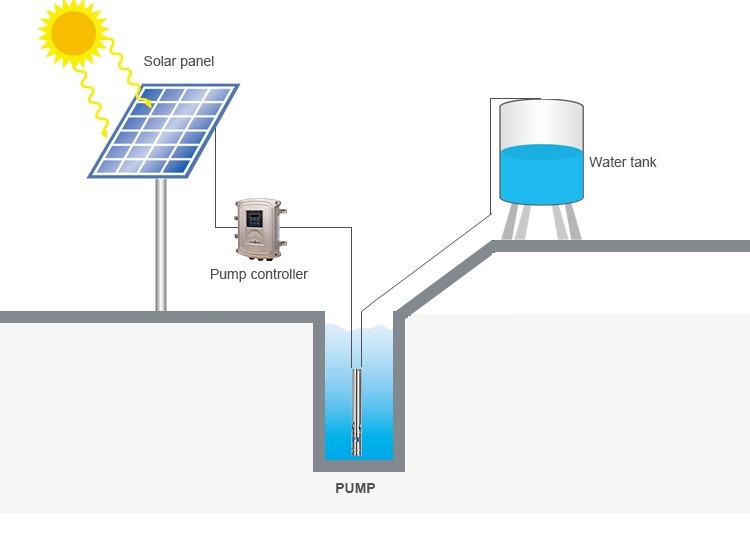
Solar panels are the power source of your solar panel water pump system. A proper solar pump system design matches the right solar panel size to the pump based on its power demand.
With proper panel sizing, you are sure of adequate power being generated for the solar panel water pump during peak sunlight hours, which in turn ensures consistent pump operation. When deciding the panel sizes for the solar pump system design, consider daily sunlight availability and seasonal variations, and not just the pump power requirements alone.
Improper sizing has its downsides at either end. Undersized solar panels lead to weak system performance, while oversized panels will typically increase costs unnecessarily.
- Use an efficient solar pump controller
A solar panel water pump system does not operate at a fixed power level. As sunlight intensity changes from dawn to midday to late afternoon, the power available from the panels fluctuates continuously.
To ensure that the pump receives adequate power to deliver the required flow throughout, the solar pump system design needs to incorporate a solar pump inverter.
This component plays a crucial role in system performance by regulating voltage and current, protecting the pump from damage, and optimizing energy use.
Advanced solar pump controllers (such as MPPT types) adjust to changing sunlight conditions, improving efficiency and water output from the system.
- Consider The Role of a Solar Pump Inverter
Most submersible solar pumps designed for agricultural use run on DC power (direct current, produced by solar panels) and are connected directly to panels via the MPPT controller without any need for inversion. This configuration is the most efficient and simplest.
A solar pump inverter becomes relevant in two specific situations. The first is when an existing AC pump, one designed to run on mains electricity, is being converted to solar power. Rather than replacing the pump, an inverter converts the DC output of the solar panels to the AC current the existing motor requires to run.
The second situation is hybrid systems, where the pump needs to run on both solar power and grid or generator power, depending on availability. An inverter-based system allows seamless switching between power sources, ensuring the continuity of the water supply regardless of whether the sun is shining or not.
- Plan For Water Storage Instead of Batteries
Instead of relying on expensive battery backup systems for your solar panel water pump, many farms use water storage tanks as a practical solution. While at it, ensure you position the tank storage to work with gravity, making them an active part of the water distribution system.
Positioned correctly by raising tanks about 10meters above the field, the tanks can eliminate the need for a pressure pump to feed irrigation, reduce energy demand, and provide a buffer that doubles pumping hours from irrigation scheduling.
- Choose The Pipe Sizing for Flow Rate, Not Just Pressure
Pipe sizing is easily an underappreciated element of the solar pump system design. Ensure the delivery pipe is properly matched to the pump’s flow rate to avoid friction losses that reduce effective output and increase the load on the pump motor.
Additionally, optimize the pipe layout and distribution for optimal performance. Specifically, consider using an appropriate pipe diameter to reduce friction loss, minimizing unnecessary bends and long distances, and ensuring proper pressure for irrigation systems.
Original Reliable Solar Water Pumps in Nairobi, Kenya at Irrihub Ke, +254 112 148 880
If you are looking to buy a reliable solar water pump in Kenya, Irrihub has some nice offers you may consider. We sell solar pumps as independent units or as complete solutions (kits). The complete solutions include:
- Submersible brushless pump
- 600W solar panels
- Delivery pipe 25MM
- 70M head
- Flow rate of 2300 L/hr.
- Solar panels
- Pipes and fittings
- Cables
- MPPT controller
- Full installation
Parting Shot on Solar Pump System Design
Effective solar pump system design is foundational to reliable and efficient water delivery wherever it is required. And this requires precise matching of your water needs, system components, and environmental conditions to create a system that outperforms a more expensively specified system designed without these principles.
IrriHub Kenya offers solar pumping installations that begin with a detailed site assessment that feeds directly into system design. This explains why systems installed by IrriHub have such a high success rate regardless of scale.
I hope this write-up helps you out.