When most people think about a solar pump system, they picture the panels and the pump itself. The component that quietly holds everything together, the solar pump controller, rarely gets the attention it deserves.
Yet without the solar pump controller, your solar panels and pump motor cannot communicate effectively, and the entire system either underperforms or breaks down prematurely. Understanding what a solar pump controller does, and the key difference between the two main types: MPPT and PWM, helps you make a better buying decision and get more from your system over the long term.
What Does a Solar Pump Controller Do?
A solar pump controller sits between the solar panels and the pump motor, managing the flow of electrical power between them. It performs several critical functions simultaneously.
First, it regulates voltage and current. Solar panels produce variable output depending on sunlight intensity, temperature, and cloud cover. Without regulation, this variability would send unstable power directly to the pump motor, causing erratic operation and premature wear.
Second, it optimizes the harvesting of electrical energy from the solar panels so the pump receives the maximum power available at any given moment, particularly important during early morning, late afternoon, or overcast conditions when panel output is below its peak.
Third, it provides protection. A high-quality solar pump controller monitors for conditions that could damage the pump and safely shuts the system down when they arise. These protections typically include dry-run protection (switching off the pump if the water source runs dry), overvoltage and undervoltage protection, overcurrent protection, and high-temperature shutdown.
Fourth, many modern controllers support variable-speed operation. Rather than running the pump at full speed or not at all, the controller can modulate pump speed in proportion to available solar power, reducing mechanical stress during low-light periods and extending the pump's working life.
On more advanced systems, the controller also displays real-time data, including input voltage, current, power, pump speed, and fault codes, making monitoring and troubleshooting the solar water pump significantly easier.
PWM Controllers: How They Work
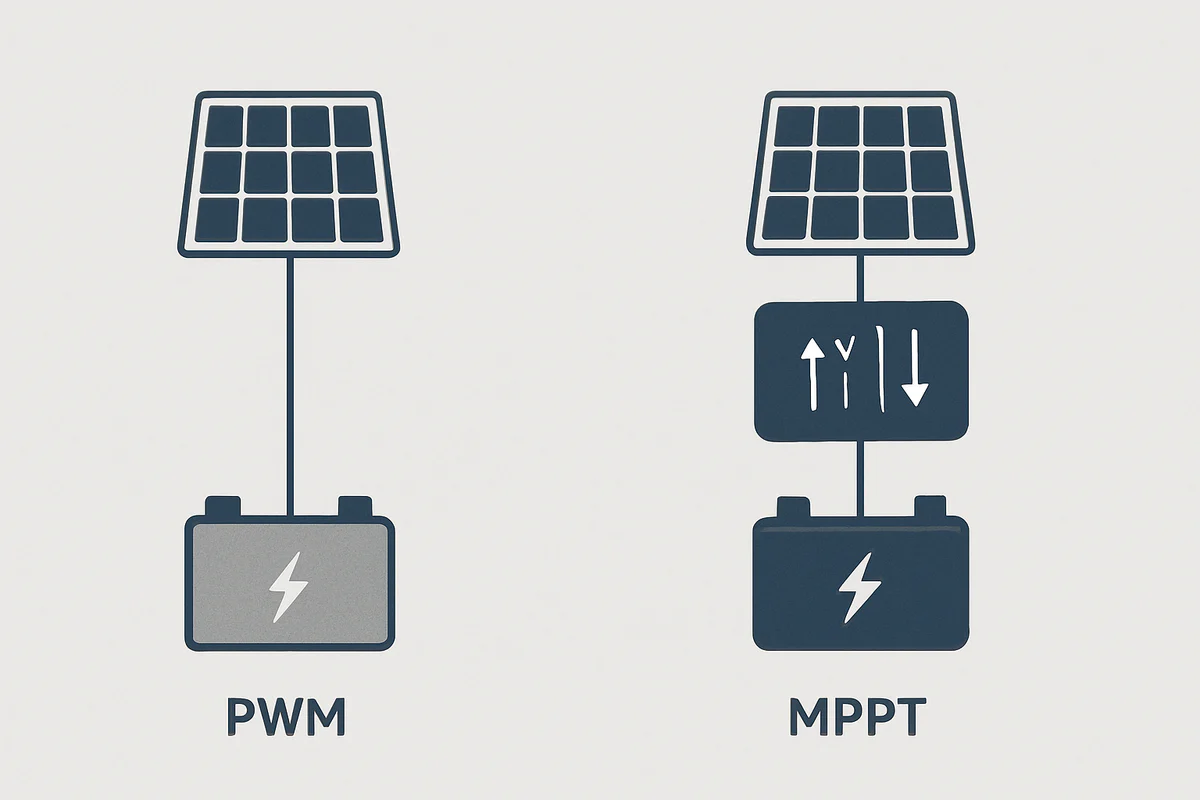
PWM stands for Pulse Width Modulation. A PWM controller works by directly connecting the solar array to the pump or battery and regulating the charge by rapidly switching the connection on and off. Widening or narrowing the pulse to control the amount of energy passed through.
The key limitation of PWM is that it pulls the panel's operating voltage down to match the battery or motor voltage. Any difference between the panel's optimal operating voltage and the load voltage is essentially wasted rather than converted into usable power.
PWM controllers are simpler in design, more affordable, and reliable enough for smaller, straightforward setups. For a small solar water pump drawing from a shallow source with a modest panel array, PWM can be a perfectly adequate and cost-effective choice.
MPPT Controllers: How They Work
MPPT stands for Maximum Power Point Tracking. This is a more sophisticated technology that continuously scans the solar array's output to identify the precise voltage and current combination at which it is producing the maximum possible power; the "maximum power point." The controller then converts this optimal voltage down to whatever the pump motor or battery requires, transferring the additional voltage as increased current rather than losing it as heat.
The practical result is a meaningfully higher energy harvest from the same panel array. In variable conditions, such as partial cloud, early morning, and temperature fluctuations, an MPPT solar pump controller can deliver up to 30% more usable power than a PWM unit of equivalent rating.
MPPT controllers also handle mismatches between the voltage of your panel array and motor voltage more gracefully, which matters when using modern high-voltage panels with lower-voltage pump motors, a combination that is increasingly common as the solar panel technology evolves.
MPPT vs PWM: Which Should You Choose?
The right choice between MPPT vs PWM depends on your system's scale, budget, and operating conditions.
Small, budget-conscious systems
This can be a compact surface pump drawing from a dam or shallow well for a small plot. Here, a PWM controller can serve adequately, especially if the panel array is sized conservatively and sunlight conditions are fairly consistent.
Medium to large systems
These include borehole applications, farms with significant daily water requirements, or any setup where maximizing output during variable weather is important. Here, an MPPT controller is the better investment.
The improved efficiency translates directly into more water delivered per day, faster tank fill times, and reduced strain on the pump during low-light hours.
Deep well and borehole applications
For these specifically, the MPPT controller's ability to soft-start the pump motor and modulate speed is particularly valuable. Starting a submersible pump at full voltage causes a current surge that can stress motor windings over time. An MPPT controller manages this ramp-up smoothly, helping to extend the motor’s service life.
In Kenya's climate, where peak sun hours are generally good but early mornings and overcast periods do occur, the efficiency advantage of MPPT becomes relevant on a daily basis. If you have a serious agricultural or domestic installation, the MPPT controller is the professional standard to go for.
The Solar Pump Inverter: A Related Component
In systems where the pump motor runs on AC power rather than DC, a solar pump inverter takes on the role of converting the DC electricity from the panels into AC power for the motor.
Many modern solar pump inverters integrate the MPPT function alongside the DC-to-AC conversion, combining both roles in a single unit. For three-phase AC pumps common in larger agricultural installations, a dedicated solar pump inverter with built-in MPPT is generally the standard configuration.
Original Reliable Solar Water Pumps in Nairobi, Kenya at Irrihub Ke, +254 112 148 880
If you are looking to buy a reliable solar water pump in Kenya, Irrihub has some nice offers you may consider. We sell solar pumps as independent units or as complete solutions (kits). The complete solutions include:
- Submersible brushless pump
- 600W solar panels
- Delivery pipe 25MM
- 70M head
- Flow rate of 2300 L/hr.
- Solar panels
- Pipes and cables
- MPPT controller
- Full installation
Choosing a Controller: What to Look For
When selecting a solar pump controller, check for compatibility with your pump's voltage and power rating, the protection features included (dry-run, over-voltage, over-current, and temperature), whether it supports variable speed operation, and the quality of its display and monitoring functions. A unit with a clear LCD readout and accessible fault codes will make your day-to-day monitoring and troubleshooting considerably simpler.
As with most components in a solar pump system, quality pays off over time. A reliable controller that protects the pump and optimizes performance is far less expensive than replacing a motor that failed due to voltage surges or repeated dry-run damage.