DIY Hydroponic Tower vs Ready-Made Systems: Which Option Is Best?
If you decide to bring your garden indoors or to your limited urban living space, you often end up with one conclusion: make it vertical. But the next logical question is, do you build a DIY hydroponic tower or buy a ready-made system like a vertical garden?
YouTube tutorials and other online guides may make building a DIY hydroponic tower simple: a few pipes, a pump, a reservoir, and you’re growing lettuce vertically. The reality of creating your own hydroponic tower is a bit more complex than that.
If you are considering producing your own food in a small space and wondering what option is best, especially amid all the information on the World Wide Web, you have just come to the right place.
Below, we provide a clear and practical breakdown of building a DIY hydroponic tower versus investing in a plug-and-play vertical garden to simplify your choices.
First Things First, What Is A DIY Hydroponic Tower?
By a DIY hydroponic tower, we are referring to a self-built vertical growing system that delivers nutrient-rich water directly to plant roots without soil. The primary idea here is that you purchase all the materials yourself, secure the required building equipment, and put together the system.
Notice that a hydroponic tower’s components include PVC pipes or vertical columns, net pots, a nutrient reservoir, a submersible pump, and a timer.
In most cases, nutrient solution is pumped to the top and trickles down through planting holes. This hydro garden tower, which applies hydroponic principles, appeals to hobbyists and experimenters because it often feels cost-effective at first.
DIY tower garden systems can be customized, offer hands-on learning, and may be satisfying to build if you are an enthusiast of handywork.
However, building the system is only the beginning. Once in place, the system requires ongoing monitoring of nutrient balance, pump performance, water quality, and system hygiene for it to be successful.
About Ready-Made Vertical Gardens
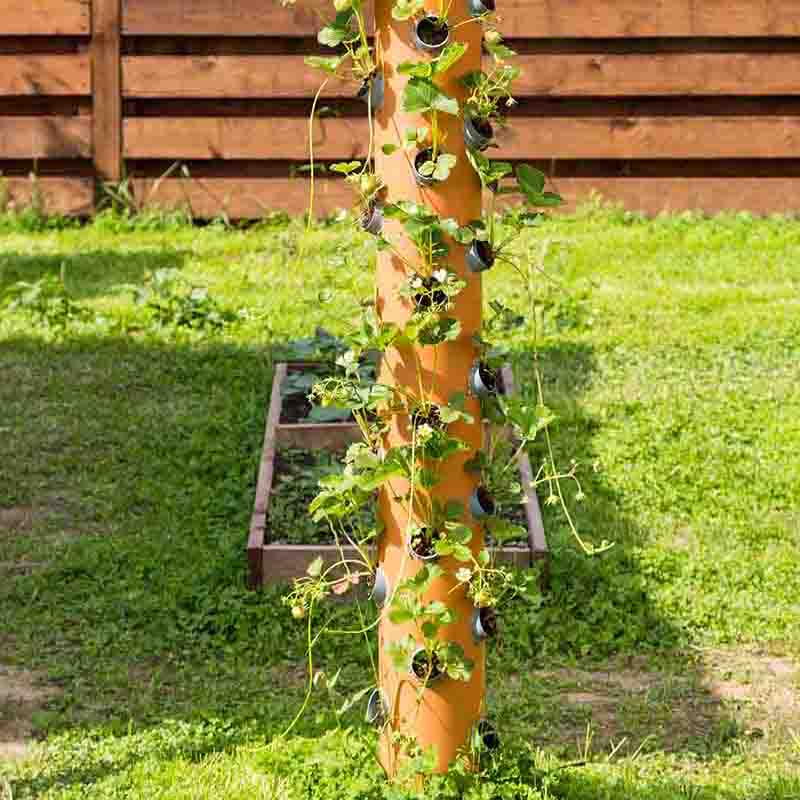
Professional vertical gardens are pre-designed structures engineered for stability, irrigation efficiency, and durability. IrriHub’s vertical gardens are made from UV-treated recycled HDPE plastic that is weather-resistant and highly durable.
Unlike hydroponic towers, many vertical garden systems are soil-based or substrate-based. Compared to hydroponics, they offer better structural strength, easier maintenance, scalability, and cleaner aesthetics for homes and commercial spaces.
Key Differences Between DIY Hydroponic Tower Vs Vertical Garden Systems
This section provides a detailed comparison of DIY hydroponic towers and ready-made vertical gardens to give you a clearer picture of each option.
- A DIY hydroponic tower is more complex
A DIY hydroponic tower requires plumbing knowledge, pump installation, accuracy in nutrient mixing, leak-proof sealing, and electrical setup. Mistakes in this system can lead to leaks, uneven water flow, or plant failure.
By contrast, vertical garden systems are typically straightforward to assemble. Many of them are plug-and-play with simple drip lines or passive watering reservoirs.
For a beginner, the technical barrier is significantly lower with structured vertical gardens.
- DIY projects appear cheaper upfront, but costs can add up
The actual costs in a DIY hydroponic project include PVC materials, pump and timer, nutrient solutions, electricity, replacement parts, and ongoing maintenance.
Vertical gardens may have a clearer upfront cost, but often require lower operating expenses. Soils and drip irrigation systems generally have fewer moving parts and reduced reliance on electricity.
In the long term, stability and durability often outweigh perceived initial savings. Also, with companies such as IrriHub, the ready-made vertical gardens are designed to be accessible and are generally cheaper than hydroponic towers upfront and in the long run.
- Pump failure can kill plants in hydroponic towers
A hydroponic tower depends on continuous pump operation, clean and balanced nutrient solution, stable power supply, and regular monitoring. If the pump fails, plant roots can dry quickly, causing the crops to die away.
Vertical gardens using soil or substrate are more resilient. Moisture remains in the medium even if irrigation is briefly interrupted.
Maintenance for vertical gardens usually involves irrigation or occasional irrigation checks, soil replenishment, and routine pruning. This simplicity makes them more reliable in environments with variable infrastructure.
When Does a DIY Hydroponic Tower Make Sense?
If your goal is to understand hydroponics deeply or experiment with nutrient science, DIY can be rewarding. More specifically, a DIY hydroponic tower is ideal for
- Learning and experimentation
- STEM education projects
- Controlled research environments
- Hobby growing in stable environments
Why Vertical Garden Systems Are Often the Better Choice
For many growers, especially in homes, schools, and institutions, vertical garden systems offer:
- Lower technical barriers
- Easier installation
- Reduced power dependence
- Lower operating costs
- Greater long-term reliability
Structured vertical systems also integrate better with drip irrigation and climate-smart farming approaches, making them adaptable to Kenyan realities.
Reliable Vertical Garden Systems in Nairobi, Kenya at Irrihub Ke, +254 112 148 880
If you are looking to set up a high-quality vertical garden system in Kenya, IrriHub offers a wide range of vertical garden products that can be supplied as independent vertical gardens or as complete vertical garden solutions. Our complete vertical garden solutions include:
- Modular vertical gardens
- Structural support frames
- Drip irrigation system
- Micro irrigation pipes, fittings, and connectors
- Filtration unit and pressure regulator
- Water storage tank
- Solar or electric water pump (where required)
- Timers and fertigation units (optional automation)
Final Thoughts
Both the DIY hydroponic tower and ready-made vertical garden systems offer pathways into vertical food production. DIY hydroponics can be an exciting educational journey, especially for experimentation and controlled setups.
However, for a household or commercial food production where reliability, simplicity, and long-term sustainability are crucial, structured vertical garden systems often provide the more practical solution.
Carefully assess your needs, infrastructure, and goals before investing. A system that matches local realities will always outperform one that looks impressive but struggles under everyday conditions.
If you have any questions, do not hesitate to contact us.